Dinosaur Bedtime Stories for Kids: Turning Dino-Obsessed Kids Into Sleepy Kids
Your kid loves dinosaurs? Channel that obsession into bedtime with dinosaur stories that educate, calm, and help dino-fans drift off to sleep.
Your child can name 47 dinosaurs but can’t remember to brush their teeth. They correct adults who say “brontosaurus” (it’s Apatosaurus, technically, though the name was reinstated in 2015 — your kid probably knows this). Their pajamas have dinosaurs. Their shoes have dinosaurs. Their lunchbox is a Stegosaurus. And at 8 PM, when you need them to wind down and sleep, their brain is still running laps through the Cretaceous Period.
You’re not going to out-stubborn a dinosaur obsession. But you can use it.
The Dinosaur Obsession Is a Superpower (Seriously)
That single-minded focus your kid has on dinosaurs? Researchers have a name for it: an “intense interest.” A study from the Universities of Indiana and Wisconsin tracked children with intense interests and found that these kids showed measurably better sustained attention, deeper information processing, and stronger persistence than peers without one.
In plain language: your kid’s dinosaur fixation is actually making them smarter.
The research, published by Joyce Alexander and colleagues, found that about a third of children between ages 2 and 6 develop an intense interest — and dinosaurs are consistently the most common one. These children don’t just memorize names. They build mental taxonomies, understand geological time periods (at least conceptually), and grasp predator-prey relationships. A four-year-old explaining the difference between a carnivore and a herbivore is performing genuine scientific classification.
So the obsession isn’t a phase to tolerate. It’s a cognitive engine. And bedtime is a perfect time to harness it.
Not All Dinosaur Stories Are Bedtime Stories
Here’s where most parents hit a wall. You think “my kid loves dinosaurs, so a dinosaur story will help them sleep.” Then you tell a story about a T-Rex hunting prey across a volcanic landscape and suddenly your child is wide awake, roaring, and pretending to eat the pillows.
Dinosaur stories for bedtime need a different gear than dinosaur stories for daytime. The goal isn’t excitement — it’s transition. You’re taking that intense interest and using it as a vehicle to carry your child from wakefulness to sleep.
The difference is the same as the difference between a car chase movie and a sunset drive. Same vehicle. Completely different speed.
Elements of a Great Dinosaur Bedtime Story
Gentle Herbivores as Protagonists
Brachiosaurus. Triceratops. Parasaurolophus. Ankylosaurus. These are your bedtime heroes — the plant-eating, slow-moving, herd-living dinosaurs that evoke safety and calm. A Brachiosaurus stretching its long neck to munch on treetop leaves is inherently soothing. A Velociraptor stalking through undergrowth is inherently not.
This doesn’t mean you ignore the predators entirely (your child will call you out). But at bedtime, the T-Rex is far away, already asleep in its cave. The story belongs to the gentle giants.
Prehistoric Landscapes as Dreamscapes
The Mesozoic Era was — conveniently for storytelling purposes — gorgeous. Lush fern valleys. Warm shallow seas. Volcanic hot springs. Dense forests with trees taller than buildings. And skies full of stars that no human eye ever saw, but that your child’s imagination can.
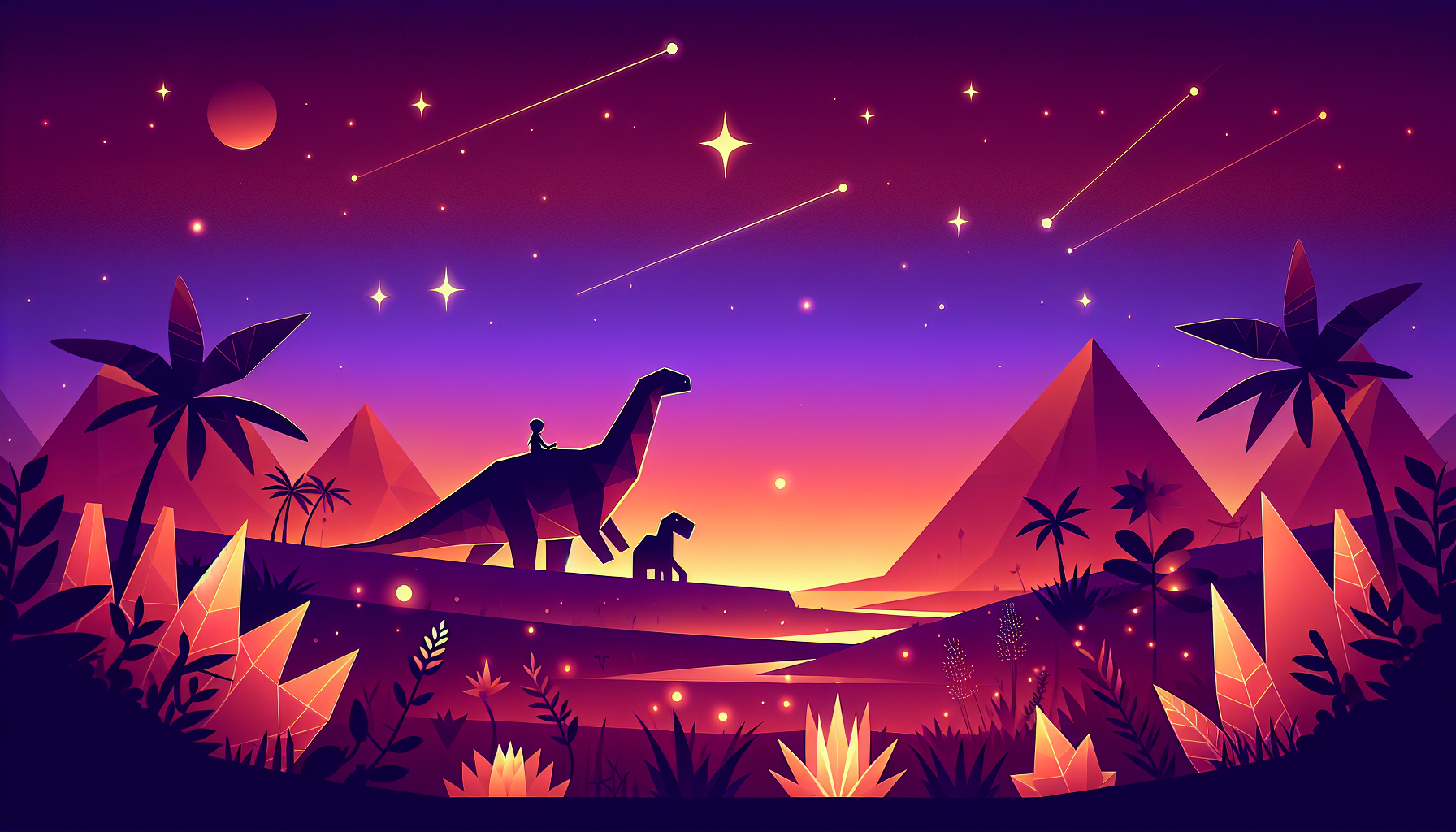
Use these settings the way you’d describe a cozy bedroom: warm, safe, enveloping. “The valley was filled with soft ferns, and the air smelled like rain. The last sunlight turned the clouds pink and orange, and everywhere, the dinosaurs were settling in for the night.”
That’s not a geography lesson. That’s a lullaby with Diplodocuses.
Sneaking in Real Facts
This is the secret weapon. Dino-obsessed kids don’t just want stories — they want stories that respect what they know. Weaving in real facts makes the story feel credible to a child who can spot a fake dinosaur fact from across the room.
“Maiasaura — whose name means ‘good mother lizard’ — curled around her nest the way she did every night. Her babies were small, no bigger than a kitten, and they pressed against her warm side.”
That’s all factual. Maiasaura really was named for its parenting behavior. The hatchlings really were small. And wrapping facts in a bedtime narrative means your child is learning while they drift off — which, if you remember the intense interest research, is exactly how their brain prefers to work.
Always End With the Dinosaur Falling Asleep
This is non-negotiable. Every dinosaur bedtime story ends the same way: the dinosaur (and, ideally, the child in the story) falls asleep. The stars come out over the Cretaceous sky. The Apatosaurus lowers its enormous head. The forest goes quiet. Everything sleeps.
The ending is a sleep cue. When your child hears the dinosaur falling asleep, their brain receives the same signal as “the end of the story means the end of the day.” After a few nights of this pattern, the ending itself starts to induce drowsiness. Pavlov, but with Pteranodons.
Classic Dinosaur Bedtime Books Worth Owning
If you want to skip the improvisation on some nights (and you should — more on that later), these books nail the dinosaur-plus-bedtime formula:
“How Do Dinosaurs Say Goodnight?” by Jane Yolen and Mark Teague. The gold standard. Simple text, beautiful illustrations, and a structure that mirrors a real bedtime routine. The dinosaur throws a tantrum, then settles down. Every dino-kid has lived this arc.
“Dinosaur vs. Bedtime” by Bob Shea. A tiny dinosaur who wins every battle — against a pile of leaves, against a bowl of pasta — but loses to bedtime. Funny, short, and deeply satisfying for kids who also feel like bedtime is the one opponent they can’t beat.
“Goodnight, Dinosaurs” by Judy Sierra. Each spread features a different dinosaur family getting ready for bed in their own way. It normalizes the idea that everyone — even a Stegosaurus — has a bedtime routine.
“Dinosaurumpus!” by Tony Mitton. A bit more energetic (there’s dancing), but it ends with all the dinosaurs falling asleep in a pile. Works well if your child needs to burn off one last burst of energy before the wind-down.
Making Up Your Own Dino Stories
You don’t need a book. You need a formula. Here’s one that works:
“[Child’s name] was walking through a quiet valley when they met a [gentle dinosaur]. The [dinosaur] was looking for [something peaceful — a place to rest, a warm spot, the perfect fern to eat]. So [child’s name] and the [dinosaur] walked together through [beautiful prehistoric landscape]. They found [the thing], and they both lay down under the [cozy detail — warm fern canopy, starry Cretaceous sky, soft mossy bank]. And they fell asleep.”
That’s it. You can tell that story in three minutes or stretch it to ten. You can change the dinosaur every night. You can add details your child cares about (if they’re a Triceratops kid, the Triceratops appears every single night — and that’s fine).
The structure is what matters: a gentle meeting, a shared journey, a peaceful destination, and sleep.
Your child might request modifications. “But what about a Spinosaurus?” Fine — a friendly Spinosaurus who’s looking for a calm river to wade in. “Can there be a volcano?” Sure — a dormant one, warm and quiet, where dinosaurs gather to sleep near the heat. Follow their lead, but steer the energy downward.
Personalized Dino Stories Through AI
For the nights when you’ve told every Triceratops story you can think of and your kid is still asking for “a new one” — Gramms generates personalized audio bedtime stories starring your child alongside their favorite dinosaurs, told in a warm, grandparent-like narration voice. Your child’s name, their preferred dinosaur, a gentle adventure, and a sleepy ending — freshly created every night. It’s designed for exactly the moment when your imagination tank is empty but your kid’s dinosaur appetite isn’t.
Age-Specific Dino Story Tips
Ages 2-3: Friendly, Simple, Repetitive
At this age, your child wants a dinosaur friend, not a dinosaur adventure. The dinosaur should be big, gentle, and do simple things: eat leaves, drink from a river, lie down in the sun. Repetition is comforting — telling the same basic story with the same dinosaur every night is not lazy, it’s developmentally appropriate. Use a warm, slow voice. Name the dinosaur. Your child will develop a relationship with it.
Ages 3-4: The Dinosaur Companion
Now the child wants to be in the story with the dinosaur. They’re riding the Brachiosaurus. They’re feeding the Triceratops. The dinosaur is their friend, and together they explore a quiet, safe world. Keep the sensory details rich — what the ferns feel like, what the prehistoric air smells like, the sound of the dinosaur’s footsteps. For more on crafting stories for this age, see our guide on personalized bedtime stories with your child as the hero.
Ages 5-6: Facts Woven Into Adventures
This is the sweet spot for dino bedtime stories. Your child wants adventure and accuracy. They want to know that the Parasaurolophus really did make sounds with its head crest, and they want a story where they hear that sound echoing across a twilight valley. Weave real facts into gentle narratives. A story about migrating Hadrosaurs settling down for the night after a long journey combines real paleontology with a natural sleep ending.
Ages 7-8: The Paleontologist Story
Older dino-kids often shift from imagining themselves with dinosaurs to imagining themselves discovering dinosaurs. A bedtime story where your child is a young paleontologist who finds a fossil, brushes it clean, and imagines the peaceful life of the dinosaur it belonged to — that respects their growing sophistication while still ending in quiet reflection.
The Obsession Fades, but the Bedtime Memories Don’t
Somewhere between ages 6 and 9, most children’s intense interest in dinosaurs softens. The encyclopedic knowledge stays (they’ll be winning trivia contests in college), but the all-consuming fire cools. They move on to space, or animals, or Minecraft, or whatever captures their expanding world.
What stays is the memory of lying in bed, eyes closed, listening to a story about a gentle Brachiosaurus walking through a fern valley under Cretaceous stars. The specific dinosaur names will blur. The feeling of safety and warmth and being carried into sleep by a story about something they loved — that’s permanent.
You have a narrow window when your child’s passion for dinosaurs is this intense. Use it. Tell the stories. Say the long Latin names wrong (they’ll correct you, and they’ll love correcting you). Let the Triceratops be the same Triceratops every night if that’s what they want. Make the world quiet and warm and full of gentle giants who always, always fall asleep at the end.
For a broader look at age-appropriate bedtime storytelling, see our complete guide to bedtime stories for kids.
Frequently Asked Questions
Why are kids so obsessed with dinosaurs?
Paleontologists and child psychologists call this an 'intense interest' — a deep, sustained focus on a specific topic common in children ages 2-6. Research from the Universities of Indiana and Wisconsin found that intense interests like dinosaurs actually boost cognitive development, improving sustained attention, knowledge processing, and persistence.
How do I make dinosaur stories calming enough for bedtime?
Focus on gentle, herbivorous dinosaurs as characters (brontosaurus, triceratops), set stories in peaceful prehistoric landscapes, use a slow narrative pace with sensory details, and always end with the dinosaur falling asleep. Avoid predator-prey dynamics or scary extinction themes at bedtime.
What are the best dinosaur bedtime stories for 3-5 year olds?
Classic picks include 'How Do Dinosaurs Say Goodnight?' by Jane Yolen, 'Dinosaur vs. Bedtime' by Bob Shea, and 'Goodnight Dinosaurs' by Judy Sierra. For personalized options, AI story apps like Gramms can generate unique dinosaur adventures starring your child every night.